
In our last post we described Liberia as a country being rebuilt without a single rulebook — a place where every road and building answers to a different specification, and where no national authority verifies that the agreed rules were followed on site. That gap matters, but it points to a bigger question most clients, contractors and even engineers rarely sit with:
Who, exactly, is checking that the materials in your project are what the paperwork says they are?
If the answer is “the contractor’s own technician,” you have a problem — not because contractors are untrustworthy, but because the system has quietly asked them to grade their own work. Independent materials testing is how serious construction markets solve that conflict. It is the subject of this piece.
What “independent testing” actually means
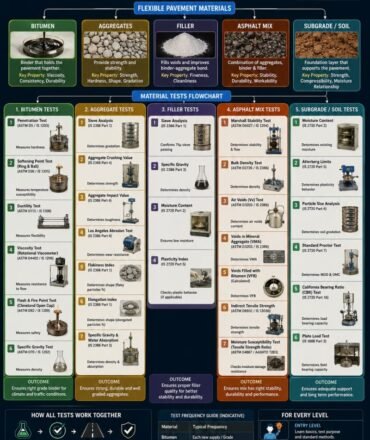
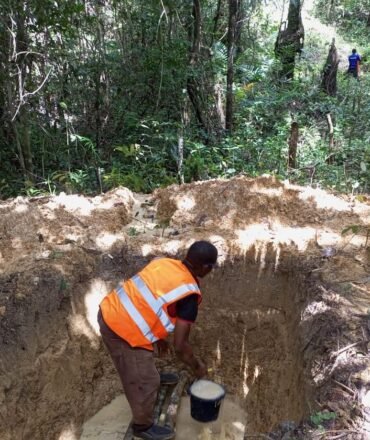
In civil engineering, materials testing covers everything that keeps the invisible parts of a project honest: the strength of concrete cubes seven and twenty-eight days after they are cast, the particle size of the aggregate under a road, the compaction of the soil subgrade before a slab goes down, the bitumen content of a wearing course. The tests themselves are straightforward and have been standardized for decades — ASTM, BS, AASHTO, EN methods are the same in Monrovia as they are in Munich.
What varies between serious construction markets and weaker ones is who performs the tests.
In an independent arrangement, three parties are kept apart:
- The contractor, who builds the asset and whose profit depends on finishing it quickly and cheaply.
- The client or supervising engineer, who signed off on the design and is accountable for the asset’s performance.
- The laboratory, which runs the tests and reports results to both — but is paid, instructed and employed by neither in a way that would change what it reports.
Most of the construction failures that make the news in West Africa — a slab that cracks before handover, a road surface that fails in the first rainy season, a wall that sags under its own load — trace back to a breakdown at exactly this joint. The lab was part of the contractor’s team. The specifications were loose. Nobody with authority to stop work was reading the test results against the design.
The three ways a test result can be wrong
Even when a lab exists on paper, test numbers can lie in three ways. A client who understands these can read a report with the right level of skepticism.
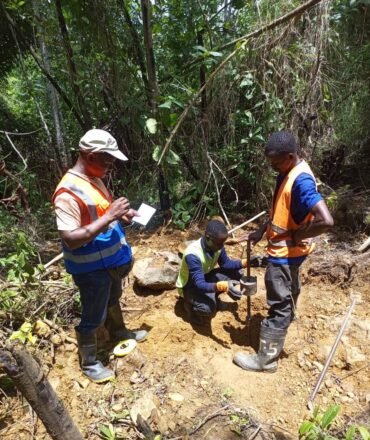
1. The sample was not what it claimed to be. A concrete cube cast at 6 p.m. on a quiet day from a contractor’s “clean” batch is not evidence of what went into the slab at 2 p.m. the day before. Independent labs insist on witnessing sample collection — or, where that is not possible, on a signed, dated sampling protocol from the lab’s own technician on site.
2. The test was not run the way the standard requires. Compressive strength is defined by a specific loading rate, a specific cube or cylinder size, a specific curing regime. Deviate on any of these and the number loses its meaning. ISO/IEC 17025 — the international standard SELA’s procedures align with — exists precisely so that a result reported by one lab means the same thing when read by another engineer across the world.
3. The result was adjusted after the test. The least detectable and most corrosive failure. A number nudged upward in a spreadsheet before it reaches the client. Independent labs defend against this by issuing results on controlled, numbered test reports with the raw instrument data traceable behind every figure.
A good lab anticipates all three of these and designs its practice to make them hard to do accidentally — and impossible to do unnoticed.
Why this matters for Liberia right now
Liberia’s construction pipeline is heavy and growing: donor-funded road rehabilitation across all fifteen counties, new schools and clinics, housing developments around Monrovia and Buchanan, port expansions, and extractive-sector infrastructure in Nimba and Bomi. The money moving through this pipeline is real and the public interest at stake is enormous.
Yet verification samples from most of these projects still travel to laboratories in Ghana, Côte d’Ivoire, South Africa or Europe for the tests that matter — because, until recently, no Liberian laboratory could offer the full suite of methods under a quality system that donors recognized. That delay has a cost. Samples degrade in transit; results come back weeks after the concrete is already in place; corrective action is almost never possible. In practice, the test becomes a formality rather than a check.
A Liberian lab operating to ISO/IEC 17025-aligned procedures changes that equation in three concrete ways:
- Turnaround drops from weeks to days.
- The lab can witness sample collection on site, closing the biggest sampling-integrity gap.
- Corrective action is possible while the pour, the lift or the layer is still accessible.
Independence, in other words, is not only about ethics. It is about time — the time it takes a result to reach a decision-maker while they can still act on it.
What a client should ask on their next project
If you are commissioning a project, three questions will tell you most of what you need to know about how your materials will be tested:
- Who collects and signs for samples on site? Any answer other than “the lab, independently of the contractor” is a flag.
- Which laboratory tests will be used, and does that lab operate under a documented quality system? Ask for the lab’s internal quality manual or its 17025 compliance status — not just a brochure.
- How quickly will results reach me, and in what form? Timeliness and traceability are the two features that separate a check from a formality.
SELA is being built around these questions. In the posts that follow, we will take each class of test — soils, concrete, aggregates, asphalt — and show what a credible result looks like, how to spot a questionable one, and what to do with the number when it lands on your desk.