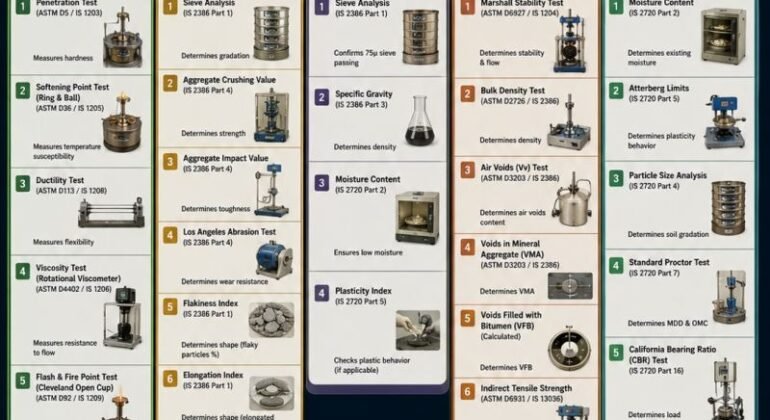

Walk any newly rehabilitated road in Liberia six months after handover and you can usually tell within fifty metres whether anyone was testing seriously while it was being built. Rutting, cracking, raveling, potholes forming at the edges — these are not weather problems. They are testing problems that showed up later.
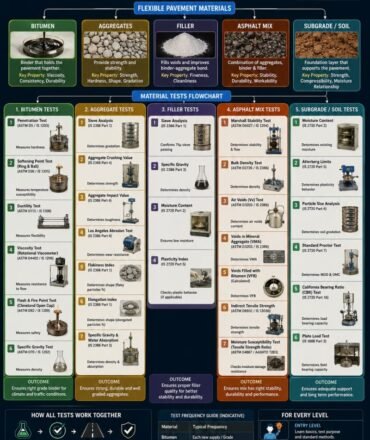
A flexible pavement — the asphalt roads that make up the majority of our paved network — is a stack of five engineered materials, each doing a specific job. Pass or fail of the whole structure depends on each layer passing its own set of tests before the next layer is placed on top of it. In this piece we walk down through the stack, show the key tests at each level, and explain why skipping any of them is almost always the reason a road fails early.
The five layers, bottom-up
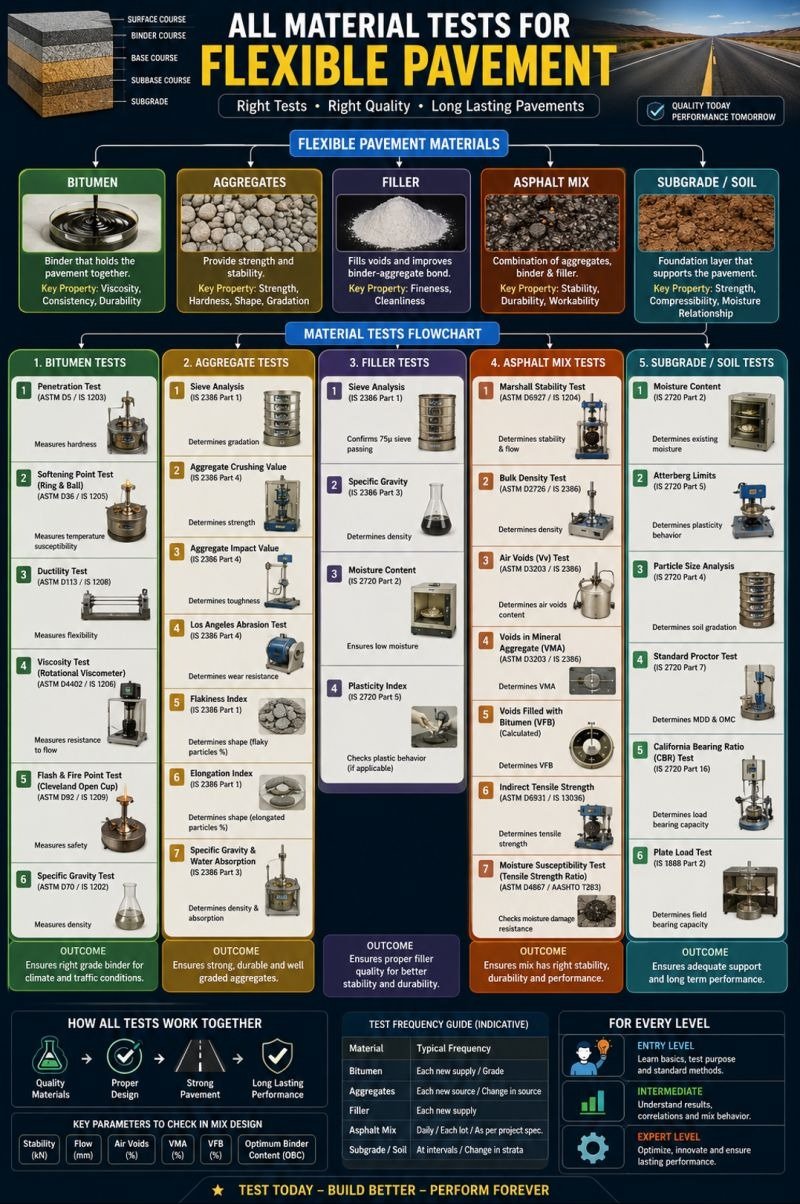
A flexible pavement is a sandwich: subgrade (the natural ground, prepared) → subbase (unbound aggregates) → base (stabilized aggregates) → binder course (asphalt) → surface course (asphalt). Each layer takes load from the one above and transmits it, spread wider, to the one below. If any layer is weaker than the design assumed, the layers above crack or deform.
1. Subgrade — the layer everything else sits on
Every pavement failure propagates upward. If the subgrade is bad, nothing above saves it.
- Moisture Content (ASTM D2216 / IS 2720 Pt 2) — confirms the soil is at the right moisture for compaction
- Atterberg Limits (IS 2720 Pt 5) — how the soil behaves with water
- Particle Size Analysis (IS 2720 Pt 4) — gradation
- Standard Proctor Test (IS 2720 Pt 7) — gives Maximum Dry Density (MDD) and Optimum Moisture Content (OMC): the targets compaction has to hit
- California Bearing Ratio (CBR) (IS 2720 Pt 16) — the single strength number that drives pavement thickness design
- Plate Load Test (IS 1888 Pt 2) — field bearing capacity
Why it matters: if the subgrade CBR comes back below the design value, the entire pavement above either needs to be thickened or the subgrade stabilized. Catching this before the first truckload of aggregate arrives can save six-figure rework later.
2. Aggregates — base and subbase
Aggregates are the stones and gravels that make up the structural core. They need to be strong, well-shaped and well-graded.
- Sieve Analysis — gradation
- Aggregate Crushing Value (ACV) — crush strength under load
- Aggregate Impact Value (AIV) — toughness under sudden load
- Los Angeles Abrasion — wear resistance under traffic
- Flakiness and Elongation Index — shape; flat and elongated particles pack poorly and fail under load
- Specific Gravity & Water Absorption
Why it matters: a road built on badly-graded or flaky aggregate ruts and ravels early. These tests are cheap. Failures are not.
3. Filler
The fine mineral dust (lime, cement, limestone dust) that fills voids between larger particles in the asphalt mix. Easy to overlook, consequential when wrong. Confirmed with sieve analysis (75-micron passing), specific gravity, moisture content and plasticity index.
4. Bitumen — the binder in the asphalt
This is what holds everything in the top layers together. Six core tests tell you if the binder will perform.
- Penetration Test (ASTM D5 / IS 1203) — hardness
- Softening Point, Ring & Ball (ASTM D36 / IS 1205) — temperature susceptibility
- Ductility (ASTM D113 / IS 1208) — flexibility; can it stretch without snapping
- Viscosity, Rotational (ASTM D4402 / IS 1206) — flow resistance at mixing/compaction temperatures
- Flash & Fire Point (ASTM D92 / IS 1209) — safety during handling
- Specific Gravity (ASTM D70 / IS 1202)
Why it matters in Liberia specifically: our climate is hot, humid and has a punishing rainy season. Binder that performed well in a European lab under European test temperatures may not perform the same way here. These tests have to be run on the actual batch going into our roads, not inferred from a supplier’s certificate.
5. Asphalt Mix — the finished product
Once binder, aggregates and filler are combined, the mix itself needs testing to confirm the whole will perform.
- Marshall Stability Test (ASTM D6927 / IS 1204) — stability and flow; the headline mix-design test
- Bulk Density (ASTM D2726 / IS 2386) — density
- Air Voids (Va) (ASTM D3203 / IS 2386)
- Voids in Mineral Aggregate (VMA)
- Voids Filled with Bitumen (VFB)
- Indirect Tensile Strength (ASTM D6931 / IS 13036)
- Moisture Susceptibility / Tensile Strength Ratio (ASTM D4867 / AASHTO T283) — how much strength the mix loses when wet; critical for our rainy season
Why it matters: the Marshall test is non-negotiable for any mix going into a Liberian road. It is also one of the simplest tests to run badly.
Testing is not a one-off — it is a schedule
A single road project generates something like thirty distinct test results across its five material layers, run at different frequencies:
| Material | Typical test frequency |
|---|---|
| Subgrade / soil | At intervals, and whenever strata change |
| Aggregates | At each new source, and whenever source changes |
| Filler | At each new supply |
| Bitumen | At each shipment |
| Asphalt mix | Daily, or per lot, or per project specification |
Missing even one of these at any level is often enough to produce a road that looks fine at handover and fails inside two years.
What SELA does with this
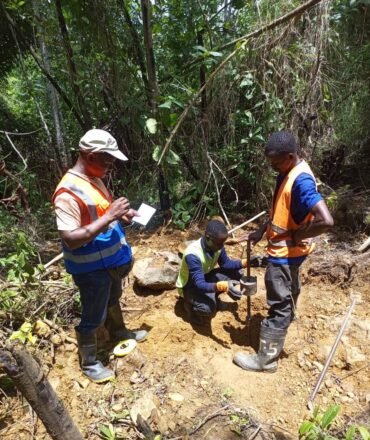
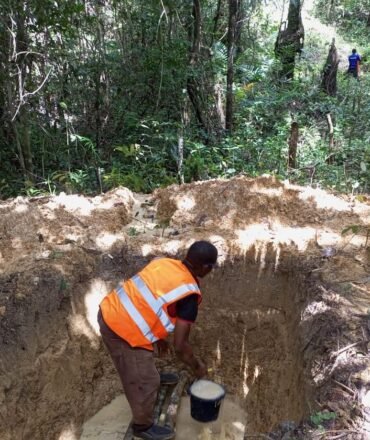
Our Transport & Pavement Engineering Lab covers the full set of flexible-pavement tests above, run to ISO/IEC 17025-aligned procedures — in Liberia, with Liberian turnaround, witnessed sampling, and results delivered to the engineer with authority to stop the next layer going down. Our site operations team has already run subgrade, aggregate and in-situ work on road projects including Gehwee–Gbedin, Brewerville–Gboae, Marplay–Seed Garden, Bomi–Swen Mecca and the Brewerville–Compoundzu corridor.
If you are commissioning or supervising a flexible pavement project, three questions are worth asking before the first truck rolls:
- Is the full test schedule costed into the project — not just a handful of showpiece tests?
- Which laboratory runs them, and under what quality system?
- How quickly do results reach the engineer with authority to stop the next layer going down?
Test today. Build better. Perform forever.